FLEXSYS
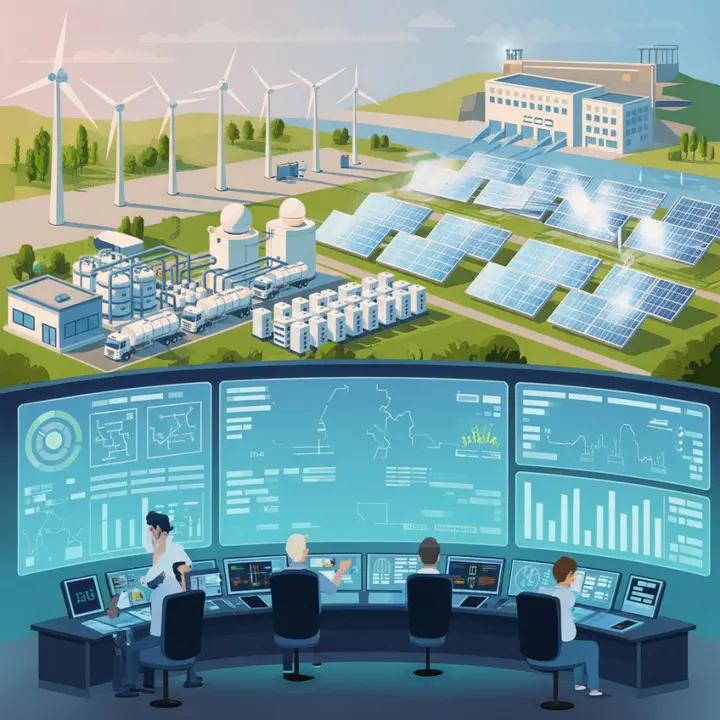
Implementation of flexibility sources and advanced control algorithms to support modern power systems with high share of renewable energy sources
Global power systems are undergoing a profound transformation driven by the imperative of decarbonization and the transition toward sustainable, low-carbon energy models. In this context, renewable energy sources (RES) – particularly solar power plants and wind farms – are experiencing significant growth, raising their share in global electricity generation, together with hydropower, to over 30%. Although essential for reducing greenhouse gas emissions, these variable sources introduce a range of technical challenges related to production fluctuations, grid stability, demand management, and overall system cost-effectiveness.
The FLEXSYS project addresses these challenges by exploring innovative solutions for the systematic and coordinated management of flexibility resources at the power system level. The project’s main objective is to ensure the stable integration of RES through the application of advanced models and control strategies for flexibility resources, with particular focus on technologies such as battery energy storage systems, electric vehicles, pumped-storage hydropower plants, and large consumers such as PEM electrolyzers. FLEXSYS includes theoretical modeling, the design of hybrid converters and control algorithms based on model predictive control (MPC) and artificial intelligence/machine learning (AI/ML) methods, as well as multi-level optimization. The developed solutions are validated through simulations, Hardware-in-the-Loop testing, and experimental validation on real system platforms. The project results aim to contribute to a more resilient, sustainable, and efficient energy system, supporting European decarbonization and security-of-supply objectives.
Project Objectives:
The project is focused on the development of innovative scientific and technological solutions in the field of flexibility management in power systems with a high share of renewable energy sources. The key objectives include:
- Development of accurate and computationally efficient models of flexibility resources such as battery energy storage systems, supercapacitors, electric vehicles (V2G), pumped-storage hydropower plants, and controllable demand (O1),
- Implementation of advanced control strategies based on Model Predictive Control (MPC) and artificial intelligence/machine learning (AI/ML) methods, including forecasting tools for key variables such as renewable generation, demand, and electricity prices (O2),
- Development of optimization models for microgrid management and flexibility modeling in transmission and distribution networks (O3),
- Design and prototyping of a hybrid power converter integrating multiple energy sources and enabling application in V2G systems (O4),
- Analysis of dynamic stability and transient phenomena in systems with high RES penetration using EMT simulations and machine learning methods (O5),
- Validation of developed solutions through simulations, Hardware-in-the-Loop (HIL) testing, and real-world experimental validation (O6),
- Dissemination of results through scientific publications, conferences, technical reports, and open-access tools (O7).
Project Leader: prof. Damir Jakus
Project Value: 238.050 €
Project Duration: 10/2025 - 10/2029

Funding Source: Funded by the European Union - NextGenerationEU
Damir Jakus
Head of Department of Power Engineering
My research interests include power system optimization and planning, RES integration, electricity market modeling.